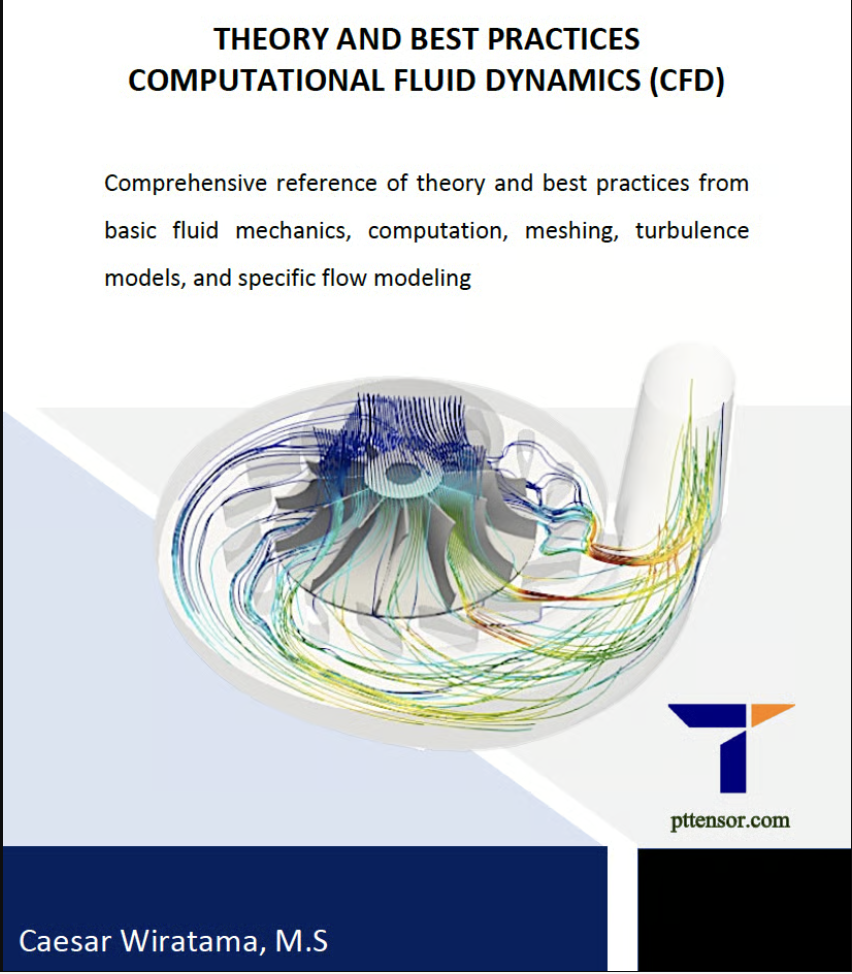
Theory and Best Practices Computational Fluid Dynamics
$25.00
Comprehensive reference of theory and best practices from
basic fluid mechanics, computation, meshing, turbulence
models, and specific flow modeling
The latest product is 1st Revision
Overview table of contents: https://www.researchgate.net/publication/377382533_THEORY_AND_BEST_PRACTICES_COMPUTATIONAL_FLUID_DYNAMICS_CFD
This book offers a comprehensive and structured journey through the theory, practice, and modern applications of Computational Fluid Dynamics (CFD). It begins by introducing CFD as both a scientific discipline and an industrial tool, covering its historical development, typical workflows, and its role in solving real-world engineering problems. Early chapters focus on the fundamental principles of fluid dynamics, including key flow parameters, governing equations, and special flow regimes such as compressible and inviscid flows. This grounding ensures that readers develop a strong conceptual understanding before moving into more advanced computational topics.
A significant portion of the book is dedicated to the numerical and modeling foundations of CFD. Topics such as meshing strategies, mesh quality, grid independence testing, and advanced techniques like overset and dynamic meshes are discussed in detail. The text also explores domain reduction methods, computational schemes, and boundary condition treatments, emphasizing how modeling choices influence accuracy, stability, and computational cost. These chapters bridge the gap between theory and implementation, helping readers understand how physical equations are translated into solvable numerical systems.
The book then delves into specialized modeling areas that are central to modern CFD practice. These include turbulence modeling (from RANS to LES and hybrid approaches), heat transfer, combustion, multiphase flow, discrete phase modeling, and thermal comfort analysis. Each topic is treated both physically and numerically, explaining not only the governing concepts but also how they are implemented in CFD solvers. Practical considerations such as wall functions, near-wall treatment, and model selection are emphasized, making the material highly relevant for applied engineers and researchers.
Finally, the book addresses advanced and emerging topics such as parallel computing and the integration of CFD with machine learning. These chapters highlight how large-scale simulations are efficiently executed on modern hardware and how data-driven approaches are reshaping turbulence modeling, surrogate modeling, and solver acceleration. Overall, the book is designed as a complete reference for students, engineers, and researchers—guiding them from fundamental principles to cutting-edge developments in CFD, with a strong focus on practical applicability and best practices.